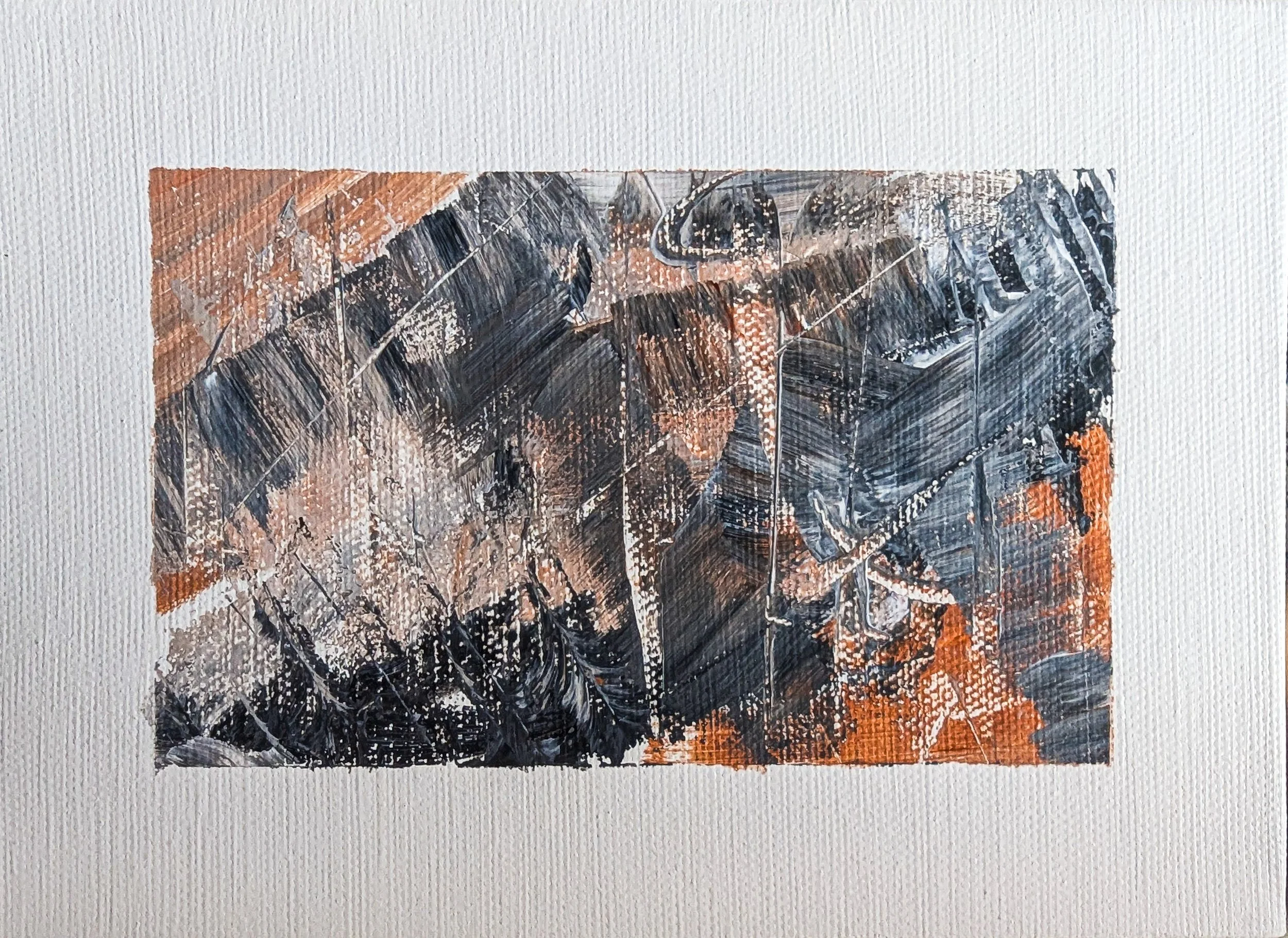
Brian Mahaney, untitled, acrylic on canvas board, 2026
A photograph has always seemed to promise something no other kind of image could. A painting interprets. A drawing invents. A written account depends on the judgment of whoever wrote it. But a photograph appeared to sit closer to the world than any of these, because it was made by a machine that recorded whatever stood in front of it. The camera opened, and light did the rest. Because of that, a photograph came to feel less like a statement about the world and more like a piece of it, carried back intact.
The promise underneath that feeling is simple. Someone was there. Someone stood in a particular place, at a particular moment, and something real entered the lens. Before a photograph says anything about beauty or meaning, it certifies that much. A person was present, and this is what stood before them. Everything else about the medium could be argued over. That could not. It was the floor the whole thing stood on.
That floor held for the better part of two centuries. A photograph might be composed, staged, retouched, or captioned into a lie, but it could not be made without someone carrying a camera to a place and pointing it at something. The manipulations people worried about were all manipulations of a real moment. They assumed the moment. Consider three of the most famous photographs ever made, and notice that every argument about them takes the presence for granted.
Dorothea Lange's Migrant Mother is remembered as a direct window into the suffering of the Great Depression, and the hardship in it was real. The family was living in genuine desperation. But Lange did not come upon that composition and record it in a single frame. She made several exposures as she worked toward the image, moving closer, adjusting her position, at one point asking the children to turn their faces away from the camera. The photograph that became an emblem of an era was the product of decisions made in the moment. Its power is real, and so is its construction.
The photograph of American soldiers raising the flag on Iwo Jima, made by Joe Rosenthal, carries the same complication. It has come to stand for sacrifice and shared resolve, and the moment it shows did occur. But it was not the first flag raised on that hill. A smaller flag had gone up earlier in the day. The image that entered public memory records a second flag, raised later.
Robert Capa's The Falling Soldier pushes the question as far as it will go. The image appears to show a man at the instant a bullet ends his life, and for decades it was treated as proof that a camera could catch the exact threshold between living and dying. Historians have argued over it ever since. Some hold that the moment is genuine. Others believe it may have been staged during a training exercise, far from any battlefield. The dispute has never been settled.
Notice what none of these arguments touch. No one questioned whether Lange stood in that camp, whether Rosenthal was on that hill, or whether Capa was in Spain. The disputes were about staging, timing, and framing, which is to say about what each photographer did while present. The presence itself was never on the table. It was the one thing these images never had to defend, because a photograph could not exist without it. Roland Barthes gave this its precise name. What a photograph certifies, he argued, is not that its subject was beautiful or important, but only that it had been. The thing existed, in front of the lens, at that moment. Everything else could be arranged. That, he thought, could not be faked. It was the source of the quiet grief he felt looking at old photographs, the pull of something that certainly existed and is now gone.
That is the floor. Here is where it drops.
An image can now be generated that carries every visual mark of a photograph, the right fall of light, the texture of a real place, the small incidental details the eye reads as evidence, and nobody stood anywhere. No one raised a camera. Nothing was in front of a lens, because there was no lens. The moment Barthes said a photograph could never fake is now the cheapest thing in the image to produce. The one property photography could always claim as its own, the that-has-been, can be manufactured to order by something that was nowhere and saw nothing.
And the discovery inside that rupture is worse than the rupture itself. If a generated image is indistinguishable from a photograph, then the presence a photograph seemed to prove was never actually in the photograph. It was never a visible property. We had simply been reading it in, supplying it ourselves, trusting that behind every such image was a person who had been there. The machine did not steal presence out of the picture. It revealed that presence had never been in the picture to begin with. We had been taking it on faith the entire time and calling it evidence.
Which means two photographs can be identical in every respect the eye can reach, one made by someone who stood in a place and looked hard at it, the other made on reflex, the camera up and down before the person saw anything at all, and nothing in either image can tell them apart. The looking leaves no mark. It never did.
For much of my time as a photographer, I treated an image as a question of what ended up in the frame. Composition, light, timing, the coherence of the result. If the photograph held together, it had done its job. I never examined the quality of attention I brought to the moment before the shutter, because nothing in the finished picture seemed to depend on it. Some of my strongest photographs are ones I almost did not take, made in the moments I stopped trying to produce something and simply looked. Others, made in the same places on the same days, are technically clean and completely empty. The camera came up before I had actually seen anything, as though the picture were a receipt proving I had been present. I can feel the difference between those two kinds of photograph in my own work. And I cannot point to it in the file, because it is not in the file. It was in me, at the moment of making, and it stayed there.
That is what a photograph was always proving, in the years when it still seemed to prove anything. Not that something stood in front of a lens, which any capable system can now fabricate. That a person stood behind one and paid enough attention to a piece of the world to stop and take it. And that was never something a viewer could verify. It turns out it is not something I can verify either, looking back at my own photographs years later. I cannot always tell, from the image alone, whether I was there in the only sense that matters, or whether I merely stood in the place and let the camera do the seeing for me.
The trouble generated images bring to photography was never that we can no longer trust the picture. It is that the picture was never where the proof lived. A machine can now supply the standing-there. What it cannot supply is the seeing, the particular attention a particular person paid to a piece of the world before deciding it was worth keeping. That was always the real content of a photograph, hidden behind the visible one. Everything a camera records can now be counterfeited except the one thing that was never in the file: whether anyone was awake to what was in front of them. That is no longer the least important thing about a photograph. It is the only thing left that a photograph cannot fake, which means it is the only thing that was ever really ours to give.